
The Private Label Cosmetics Manufacturing Process: From Idea to Shelf

The private label cosmetics manufacturing process looks simple from the outside: choose a product, add your logo, sell. In practice, a successful launch passes through a series of decisions about formula, packaging, compliance and production. This guide walks through each step as we run it at our Istanbul facility, what you should prepare, and the mistakes that most often delay new brands.

The Private Label Cosmetics Manufacturing Process: From Idea to Shelf

Private label in brief

In private label manufacturing, a manufacturer produces a cosmetic product that is sold under your brand. You own the brand, the artwork and the customer relationship; the manufacturer provides formulation know-how, raw materials, production and packing. You can start from the manufacturer’s existing, proven formulas, which is the fastest route, or bring your own formula and use the manufacturer as a contract producer. If you are unsure which model suits you, read our comparison of OEM vs ODM cosmetics.

Whichever route you choose, the steps below apply. Their order matters: decisions made early, especially on packaging and target markets, affect everything that follows.

The private label cosmetics manufacturing process, step by step

  1. 1. Brief and concept

    You describe the product: category, target customer, key ingredients or claims, texture, fragrance, price positioning and target markets. We translate this into a technical brief and suggest whether a ready formula or custom development fits better.

  2. 2. Formula selection or development

    Our R&D chemists propose a formula from our portfolio of 400+ products, adapt one, or develop a new one. If you have your own formula, we review it for feasibility and raw material availability. R&D support is free of charge for our customers.

  3. 3. Sampling and approval

    You receive lab samples to test for texture, scent, performance and user feedback. Adjustments are made in rounds until you approve a final version, which becomes the reference for production.

  4. 4. Packaging selection and sourcing

    Bottles, jars, tubes, pumps, airless packs, caps and boxes are chosen for compatibility with the formula, dosing, filling line and your brand image. We can source packaging, including recycled or eco-conscious options, or work with components you supply.

  5. 5. Label and box artwork

    Your designer prepares artwork using the INCI list, fill quantity, batch and date information and warnings required by your market. We support with technical dimensions and design feedback so the artwork fits the pack and the line.

  6. 6. Regulatory preparation

    Your Responsible Person or regulatory consultant prepares the safety assessment and notification for your market. We supply formula and INCI information to support them. For sunscreens, SPF values are verified by laboratory SPF test.

  7. 7. Production and filling

    Once samples, packaging, artwork and documents are approved, the batch is produced under ISO 22716 GMP, checked against specification, filled on automated lines, labelled and coded with a batch number.

  8. 8. Packing, palletising and shipment

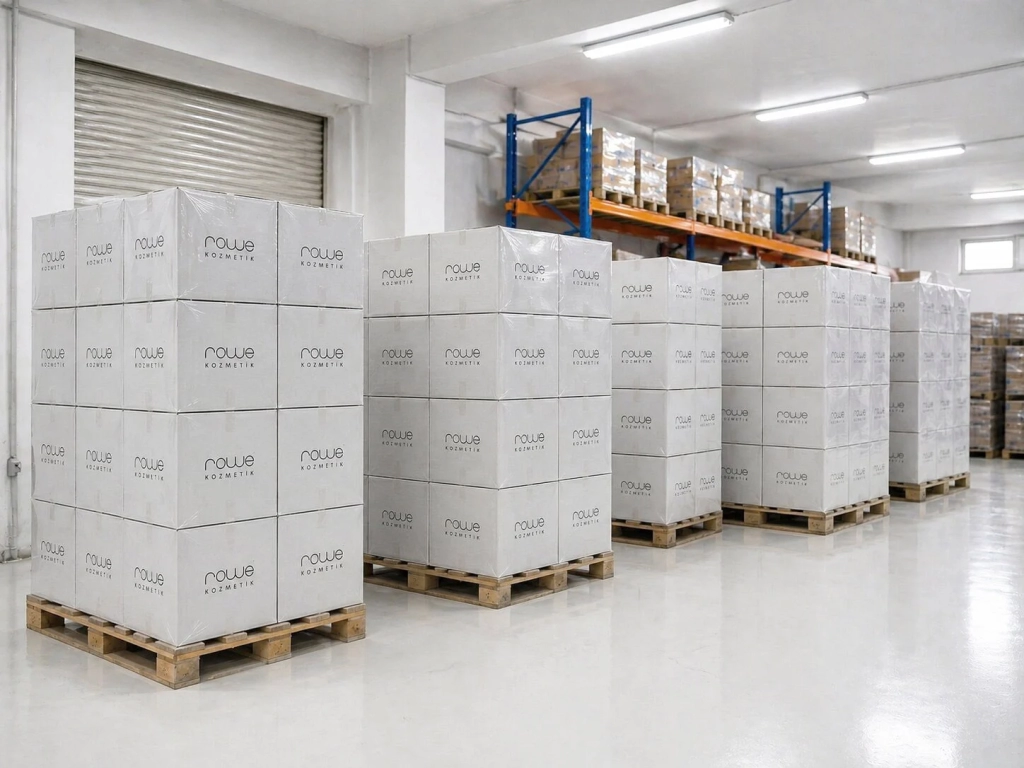
    Finished products are boxed, packed into export cartons and palletised for your warehouse, fulfilment partner or distributor. Export shipment preparation is included in our service.

  9. 9. Launch and reorders

    After launch, repeat orders are produced to the same approved formula and specification, and new SKUs can be added to the range using the same process.

What brand owners should prepare

A manufacturer can move quickly when the brand side is clear. Before contacting a private label manufacturer, try to prepare the following:

  • Positioning: who you sell to, where (e-commerce, salons, retail, distributors) and at what price range.
  • Product list: start with a focused range, often 3 to 6 SKUs, rather than a full catalogue.
  • Benchmark products: competitor or reference products that show the texture, scent or packaging you have in mind.
  • Ingredient preferences: must-have actives, and exclusions such as fragrance-free, vegan or silicone-free.
  • Packaging direction: format, material and volume, plus any sustainability requirements.
  • Target markets: these determine labelling, claims and registration requirements.
  • Regulatory partner: for the EU or UK you need a Responsible Person established there; for the USA you need to plan for FDA requirements under MoCRA.
  • Brand assets: logo, brand name checked for trademark conflicts, and a designer for artwork.

How long does each step take?

Timing varies widely with the number of sample rounds, packaging availability, artwork approval and regulatory preparation. A ready formula in stock packaging moves faster than a new formula in custom packaging. The best way to plan is to share your brief and target launch date, and we will outline a realistic schedule in the quote.

Common mistakes in the private label process

Choosing packaging after the formula is approved

A serum approved in a glass dropper may not work in an airless pump; a thick cream may not dispense from a narrow tube. Discuss packaging alongside the formula from the start to avoid repeating compatibility work.

Finalising artwork too early

Printing boxes and labels before the INCI list, fill volume and claims are final is a common source of costly reprints. Wait for the approved formula and your Responsible Person’s review.

Making claims the product cannot support

Words such as “organic”, “dermatologically tested” or “clinically proven” require specific evidence or certification. Build claims around what your formula and documents actually support.

Launching too many SKUs at once

A large first range multiplies sampling, packaging and artwork work and ties up budget in stock. A focused range that sells well is easier to expand later.

Ignoring the target market’s rules

Ingredients, labelling and notification rules differ between the EU, UK, USA and Gulf markets. Decide where you will sell before the formula is locked, not after.

Skipping the sample test with real users

Approving a sample after testing it only yourself is risky. Give samples to a small group of people who match your target customer, and collect feedback on texture, scent, absorption and packaging before you sign off the final version. Changes are simple at the sample stage and expensive once a batch has been produced.

Why run the whole process under one roof

When formulation, sampling, production and packing happen at the same site, fewer handovers mean fewer errors. At Rowe Cosmetics, our Istanbul facility combines an in-house R&D laboratory, fully automated lines with a capacity of 40,000 units per day, and export packing. About 95% of our raw materials are sourced from European suppliers, and our formulas are developed in line with EU Cosmetics Regulation (EC) No 1223/2009.

To see which formulas you could start from, visit our private label manufacturing page or browse our product categories.

Frequently Asked Questions

What is the minimum order quantity for private label cosmetics?

It depends on the product, formula and packaging. MOQ is flexible at Rowe Cosmetics, and we confirm it in your quote.

Can I change a ready formula?

Yes. Ready formulas can often be adjusted, for example fragrance, texture or an added active, and approved through samples.

Who is responsible for product registration?

The brand owner, through the Responsible Person for the target market. The manufacturer supports with formula and INCI information.

Do I need my own packaging supplier?

No. We help with packaging selection and sourcing, but you can also supply your own components.

Can the same process be used for perfumes and hair care?

Yes. The steps are the same across skin care, hair care, body care, perfumes, cleaning products and essential oils.

Ready to start your private label range?

Share your product idea and target market, and our team will suggest formulas, packaging and next steps.

Request a Manufacturing Quote

Tell us the product type, estimated quantity, packaging preference and target market — our manufacturing team will get back to you.

Phone / WhatsApp
+90 531 835 49 89 · WhatsApp

ISO 22716 (GMP) · ISO 9001 · The Vegan Society · Halal

    👋 We’re online.